


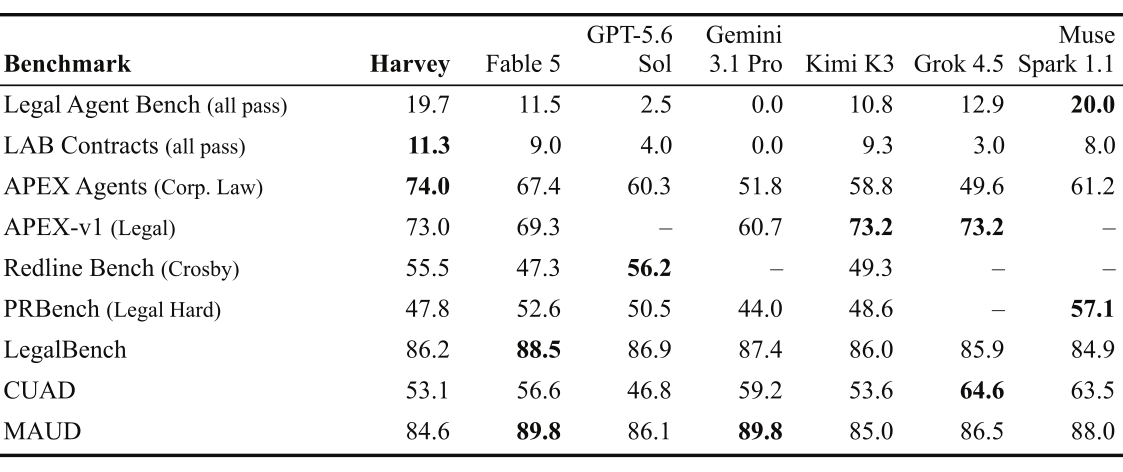
Last week, legal AI company Harvey unveiled Tenet, a model it created with Fireworks by post-training Moonshot AI’s open-weight Kimi K3.
Harvey began as an application built on top of frontier models. In 2022, integrating those models into its customers’ legal workflows was a meaningful edge. Harvey wrapped GPT-3 and later models in tools for research, drafting, document review, and firm controls, making lawyers more productive by automating work they and their teams previously handled manually.
That advantage gets thinner as the underlying models improve. Any legal AI startup can call the same OpenAI or Anthropic API. Every release, models are getting better at long documents, tool use, and complex reasoning, absorbing more of the work that once belonged to the application. The industry is quickly realizing model + workflows is no longer a moat.
Netflix went through similar struggles in a different industry. Its streaming service originally depended on content licensed from studios and when those suppliers began launching competing services, Netflix moved into original programming. It gave them a moat its partners couldn’t take away or sell to every competitor, original content found only on Netflix that may not have been studio quality, but it didn’t need to be. As they scaled, they were able to invest more into higher quality original content that widened the gap from the studios.
Harvey’s version of original programming is a specialist model. It can take a near-frontier open-weight model and apply reinforcement learning using the legal tasks, feedback, and evaluations it has developed inside customer workflows. Kimi K3 supplies the general intelligence, but Harvey teaches it what good legal work looks like. While the model may be specialist and Harvey is likely still using frontier models in some work, as Harvey scales and gathers more resources for research, there’s a world where all the work they’re doing is cycling through exclusively Harvey trained models.
Tenet wasn’t trained on customer data, but Harvey’s broader plan includes specialized models that firms can build and own. Customers can opt into a bespoke model trained on their data and kept exclusive to them. Harvey has already built one for Cuatrecasas that searches the firm’s internal knowledge and produces work in its style. That turns a firm’s documents, standards, and expertise into model performance that a generalized LLM, or another firm, can’t access.
Harvey won’t be the last app-layer company to make this move. As frontier models absorb more of the capabilities that once had to be built into workflows, wrapping those models in an interface will become less defensible. Companies will need to own models refined around the specific tasks, data, and standards of their customers. Thanks to a healthy open-source ecosystem, they’ll start with near-frontier models and make them better at completing real, end-to-end, work.
Partnerships and deals
Nvidia agreed to pay $6B to license Poolside’s Laguna models and hire more than 100 employees. Separately, it opened preliminary talks with Korean AI-chip startup Rebellions about a partnership, investment, or acquisition.
Ode with Anthropic acquired Claude implementation firm Casper Studios. Terms weren’t disclosed.
DoiT acquired AI cost-management startup Attribute for an estimated $65M. The companies didn’t confirm the price.
Serve Robotics partnered with Wonder and Grubhub to launch robot delivery in Chicago, Los Angeles, and Alexandria, Virginia. Its Moxi 2.0 rollout adds a new robotic foundation model and 15x faster perception.
Higgsfield raised a $400M Series B at a $5.4B valuation led by DST Global.
Wispr raised a $280M Series B at a $2B valuation led by Menlo Ventures and launched a new speech model.
Gravis Robotics raised a $200M Series A from SoftBank to scale autonomous earthmoving across mixed fleets and real construction sites.
Veeda AI raised more than $90M in seed funding from Khosla Ventures and Radical Ventures to build simulated worlds where embodied agents can generate training experience.
Rillet raised a $100M Series C at a $1B valuation led by ICONIQ to expand its AI-native accounting platform.
Palona AI closed a Series A that brought total funding to $20M and unveiled a multimodal AI operating layer for restaurants and other physical businesses.
Etched raised $700M at a $21B valuation led by Jane Street and shipped its first customer rack.
Orbbec and Linkerbot partnered to combine 3D vision with dexterous robotic hands for embodied AI.
LG Electronics and Nvidia are targeting 100,000 hours of robot-training data by year-end across home, manufacturing, logistics, and robotic-hand environments.
Canary Data and Perplexity partnered to bring proprietary investment-research datasets into Perplexity workflows through MCP.
Orbbec introduced four physical-AI data-collection systems and reported more than 37 hours of continuous collection with zero dropped RGB or IMU frames.
Cursor launched Origin, an early-beta code-hosting service with repositories, pull requests, code browsing, and GitHub sync.
Anything AI introduced a roster of more than 150 AI agents for engineering, operations, design, and administrative work, extending beyond its app-building platform.
OpenAI previewed Private Safety Processing to preserve Zero Data Retention across related interactions. Anthropic, which still requires 30-day retention for its most capable models, reportedly plans to let customers keep that data in their own cloud.
Generalist AI released GEN-1.5, which learns a new task from a 3-to-12-second demonstration without weight updates. It averaged 59% success across 10 tasks and reached 83% after 10 gradient steps using five minutes of data.
Foxglove launched an agentic data platform for physical AI that lets teams query robot data in natural language, compare recordings, and search images and video semantically.
Robo Robotics launched a standardized teachable-automation platform connecting demonstrations, data collection, model training, and fleet deployment. Policies taught on one unit can be deployed across identical hardware.