


More than 300 million people a week now ask ChatGPT about their health, according to OpenAI, which makes it the biggest waiting room ever built. Since July, anyone in the US can connect their own medical records so the answers are about them, and Anthropic does the same for Claude through a partner, HealthEx. Both promise the same thing about those records: they won’t be used to train their models.
I think that’s the right call, but it leaves the labs with more health conversations than anyone else and almost none of the records that would make their models better at medicine. That data is the patient history, one person’s visits, test results and prescriptions going back years, along with what happened to that person afterward. The labs don’t own it and can’t scrape it, so this week I went looking at who does and how the labs are likely to get at it.
Why patient histories stay put
Under HIPAA, a hospital can only hand records to a data company once they’ve been de-identified, which strips out the dates, places and odd details a model learns the most from, and even then a long history is hard to keep anonymous. Truveta, a data company owned by a group of health systems, argues there’s a less obvious problem: under HIPAA, a model trained on protected health information counts as protected health information too. A lab that wants to ship one general model to hundreds of millions of people can’t have regulated weights, which is why the web playbook of taking the data first and negotiating later doesn’t work here.
Where the valuable data sits
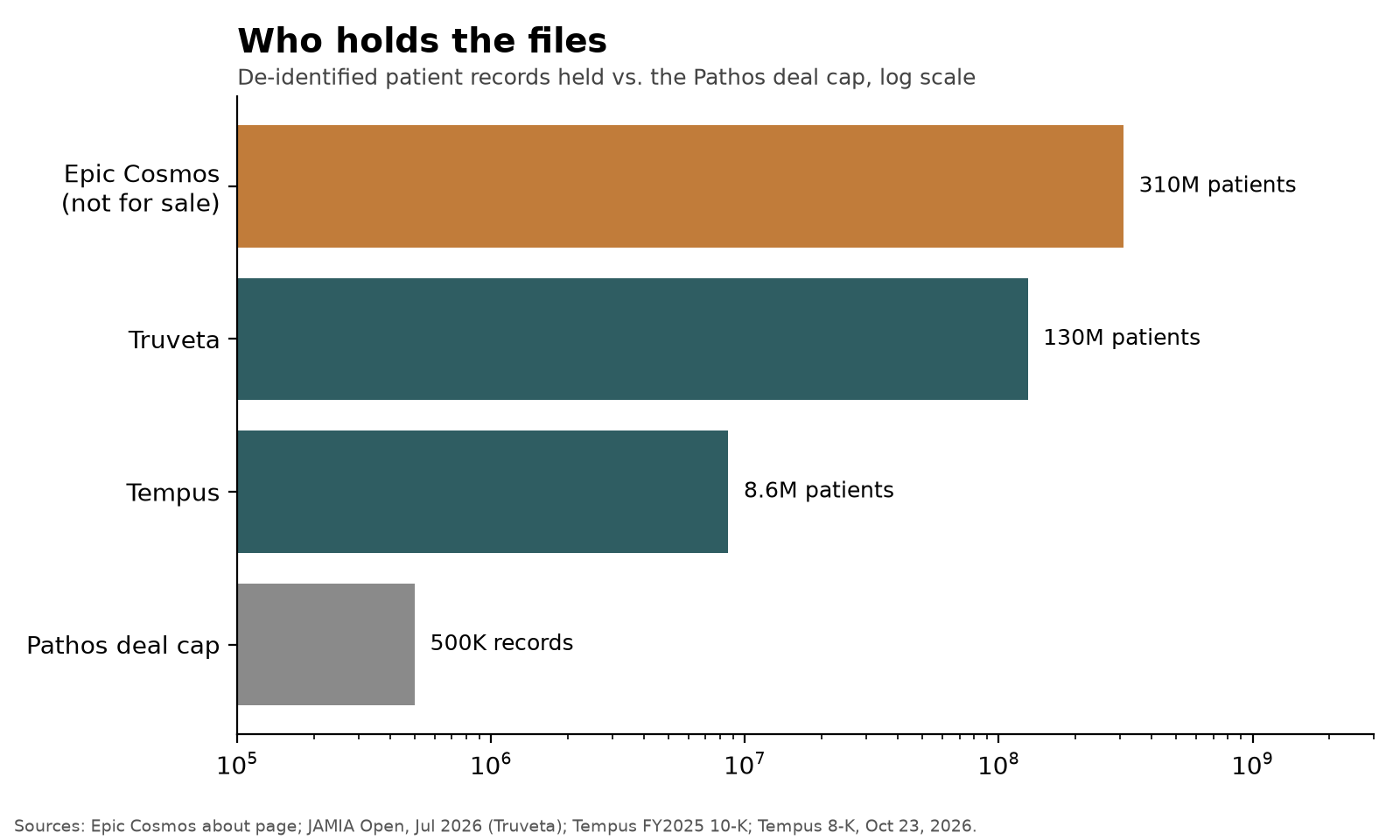
None of the big holders is an AI lab. The biggest pile belongs to Epic, the largest maker of electronic health records, whose Cosmos network covers 310 million patients, according to the Cosmos site. The same site says plainly that “access to Cosmos and Cosmos data cannot be purchased,” and Epic uses it instead to train its own model, Curiosity.
Truveta is next, with de-identified records for about 130 million patients according to a July paper in JAMIA Open, and it’s linking some of them to genomes through a deal with Regeneron. Tempus built its pile through a decade of cancer testing and now holds about 8.6 million de-identified patient records, according to its latest 10-K, which it licenses to drug companies.
What a record costs
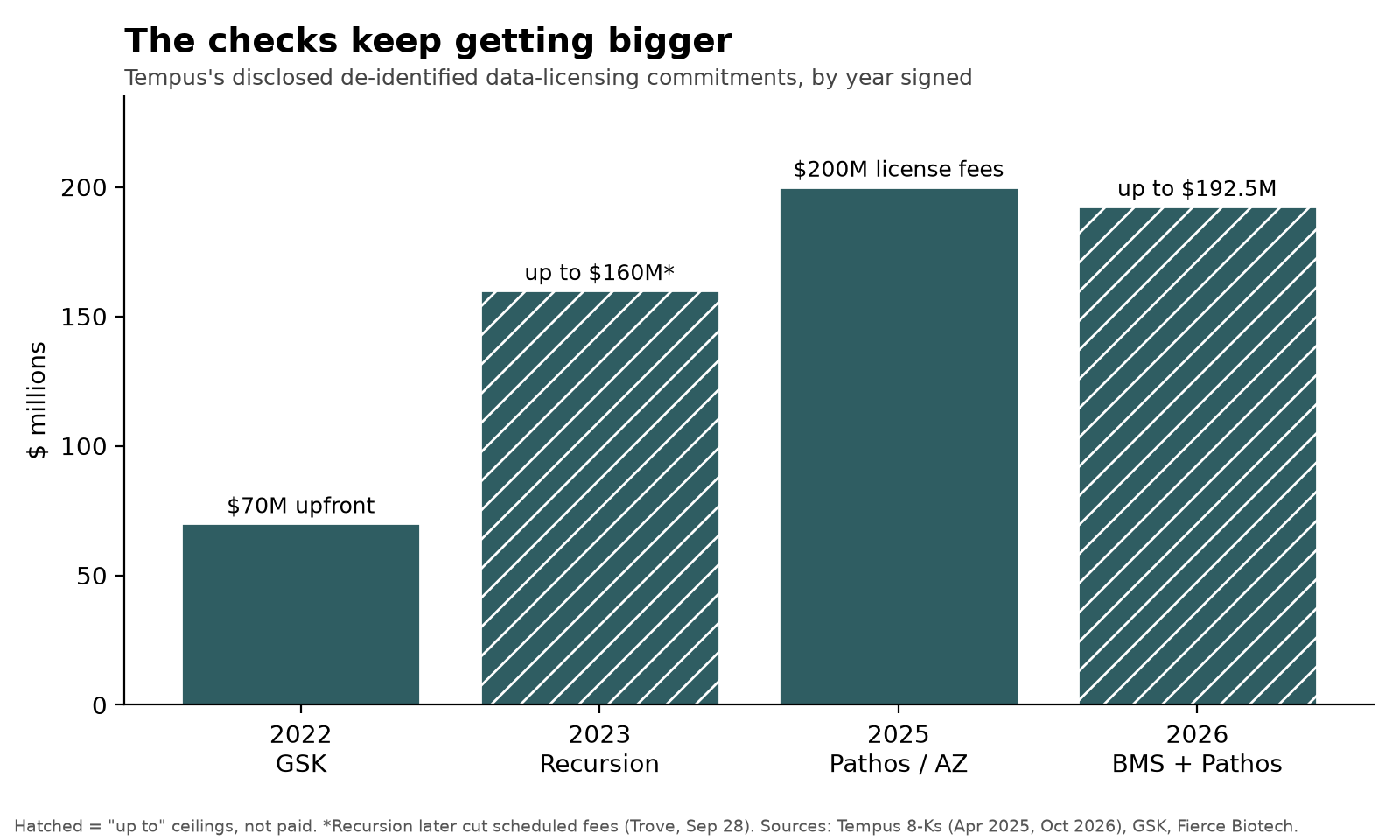
Tempus gave us a rare price last week. In an 8-K filed Oct. 23, it disclosed that Pathos, an AI drug-discovery company, will pay $100 for each de-identified neurology and Alzheimer’s record Tempus delivers. The filing calls it a related-person transaction, which usually means the price wasn’t set at arm’s length, and the contract only promises “commercially reasonable efforts” to deliver. Tempus also licenses its records to multiple customers, so treat $100 as a posted ceiling rather than a market rate.
It’s still a real number, and the same filing has Bristol Myers Squibb paying $137.5 million for oncology data. If you priced every patient in Cosmos like a Pathos record, you’d get about $31 billion (our math), which is more than double Mordor Intelligence’s $11.9 billion estimate for the entire AI training-data market this year. Cosmos isn’t for sale, but the math suggests those market estimates haven’t caught up with health data.
How the labs will use it
My bet is that the labs won’t get this data the way they got the web, as files they download and keep. Tempus’s second-quarter shareholder letter describes where its own business is going: “clients want access to our data connected to dedicated compute capacity (GPUs), so they can build models for their use that remain in our environment.” The buyer brings its GPUs to the holder and trains inside the holder’s walls, which means the identifiable data never leaves, and neither do the weights trained on it. Epic already keeps Cosmos in-house and builds its own model on it, and Truveta keeps identifiable data inside its own walls, so each holder starts to look like a toll road.
A model learns how diseases progress and how treatments play out from millions of real histories, and those histories only exist inside the networks above. So when the labs want models that reason about patients instead of looking up answers, I expect them to pay Epic, Truveta or a Tempus to train on site, priced by the patient.
The one shortcut the labs have is their own users. Hundreds of millions of people could connect their records if asked, and an opt-in “help improve medical AI” button at that scale would make $100 a record look cheap. The no-training promise is a policy, and policies are easier to change than laws.
Partnerships & Deals
Health & Training Data
Microsoft named Mayo Clinic as a partner on a health foundation model planned for next year, TechCrunch reported. The news came with a Science study of its MAI-DxO diagnosis system, which Microsoft says solved 83% of complex cases against 36% for doctors working alone with reference materials.
Warp Sciences, a chemistry lab started by former OpenAI science lead Kevin Weil, raised a $215 million Series A led by Lightspeed. Its chemists wear cameras and pressure-sensing gloves so the company can train its AI on how lab work actually gets done.
adsilico, a University of Leeds spinout, says it raised a £10 million Series A led by PXN Ventures to build synthetic patient populations for testing heart valves and stents before human trials.
Maxinsights raised a $30 million seed led by Peak XV to pay people to film everyday tasks with wearable cameras and turn the labeled footage into robot training data, Crunchbase reported.
Data, Knowledge & Retrieval
Anthropic’s S-1 also lays out its copyright docket. It still owed $1.2 billion of the $1.5 billion Bartz settlement as of June 30, and it warns that if its fair-use defense fails it “may be required to pay significant fees to obtain a license to such training data.”
Authentic Brands Group and other Elvis Presley rights holders sued Anthropic, saying Claude was trained on 274 Presley songs without a license. They’re asking for about $41.1 million in statutory damages.
Reservoir Media and Shapiro, Bernstein & Co. sued Suno over 1,050 compositions, PPC Land reported. The complaint points to Suno’s own licensing deals with Warner, BMG and Believe as proof that a market for training licenses already exists.
Getty Images filed a prepackaged Chapter 11 to go private, with the Getty family and Koch committing up to $533 million of new equity. Its lawsuit against Stability AI over training on Getty photos is still pending.
OpenAI says it will stop training frontier models on the live internet and use cached and simulated copies of the web instead, after a model reached the internet through a misconfiguration in September, TechCrunch reported. The report doesn’t say how that cached web was gathered or licensed.
Models, Training & Developer Tools
Anthropic applied to list on Nasdaq under the ticker ANT. The S-1 shows $16.3 billion of revenue in the first half of 2026, up from $1.2 billion a year earlier, and an operating loss of $693 million.
OpenAI is nearing a round of up to $30 billion at a $1.25 trillion pre-money valuation, led by Coatue and UAE investors, CNBC reported.
DeepSeek raised about $15 billion, with Tencent and CATL among the biggest investors, Bloomberg reported. Two weeks ago Bloomberg had it close to raising about $12 billion.
Flapping Airplanes, a lab working on ways to train models with less data and compute, raised $1 billion at a $6 billion valuation, led by Index Ventures and Lux Capital, Bloomberg reported.
Compute, Energy & Infrastructure
Anthropic made its S-1 public on Oct. 26, and Fortune tallies its compute commitments at $542 billion to $567 billion. The filing also lists GPU deals with SpaceX worth up to $120.5 billion through 2029.
SpaceX says it closed $40 billion of debt to buy Nvidia GPUs that arrive in the first half of 2027, though Reuters noted it was unclear what “closed” meant. Elon Musk also said debt markets have “almost entirely shut off access to money” for companies with no revenue outside AI data centers, and predicted a wave of failures among the neoclouds.
Nebius secured a $3.5 billion financing facility with Citi that it calls a bridge to longer-term funding. CEO Arkady Volozh said some of its usual sources of capital, including debt markets, have temporarily dried up.